iogentic starts an agent from a verified artifact and runs it in its own sandbox. Where a rule asks for a person, the run waits for a signature. Every step is written to one record.
Concept, November 2026. Nothing on this page is released. The run further down is a simulation with sample data.
Three products, five stages
Platform
An agent passes three products on its way to production. It is written and run in the iogentic harness. Pipesmith, a sub-brand of iogentic, builds, checks and stores it. iogentic runs it and sends the run record back.
The runtime pulls by digest and checks signature and verdict. It starts the agent only when the verdict is passed, and it writes a record of the run that development can read like a session.
Product
iogentic
Leaves the stage
Run record
1 of 5
Development
Harness
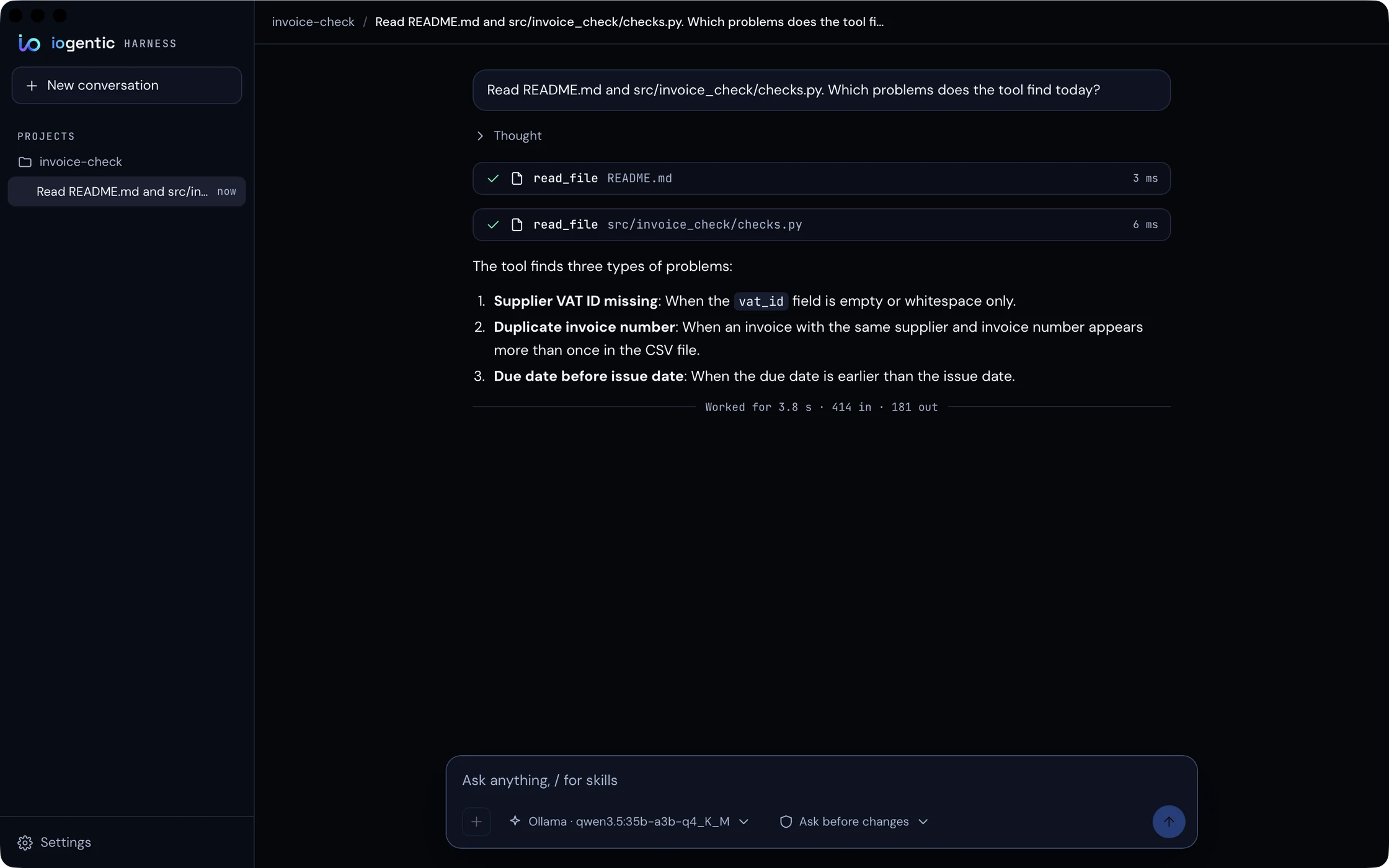
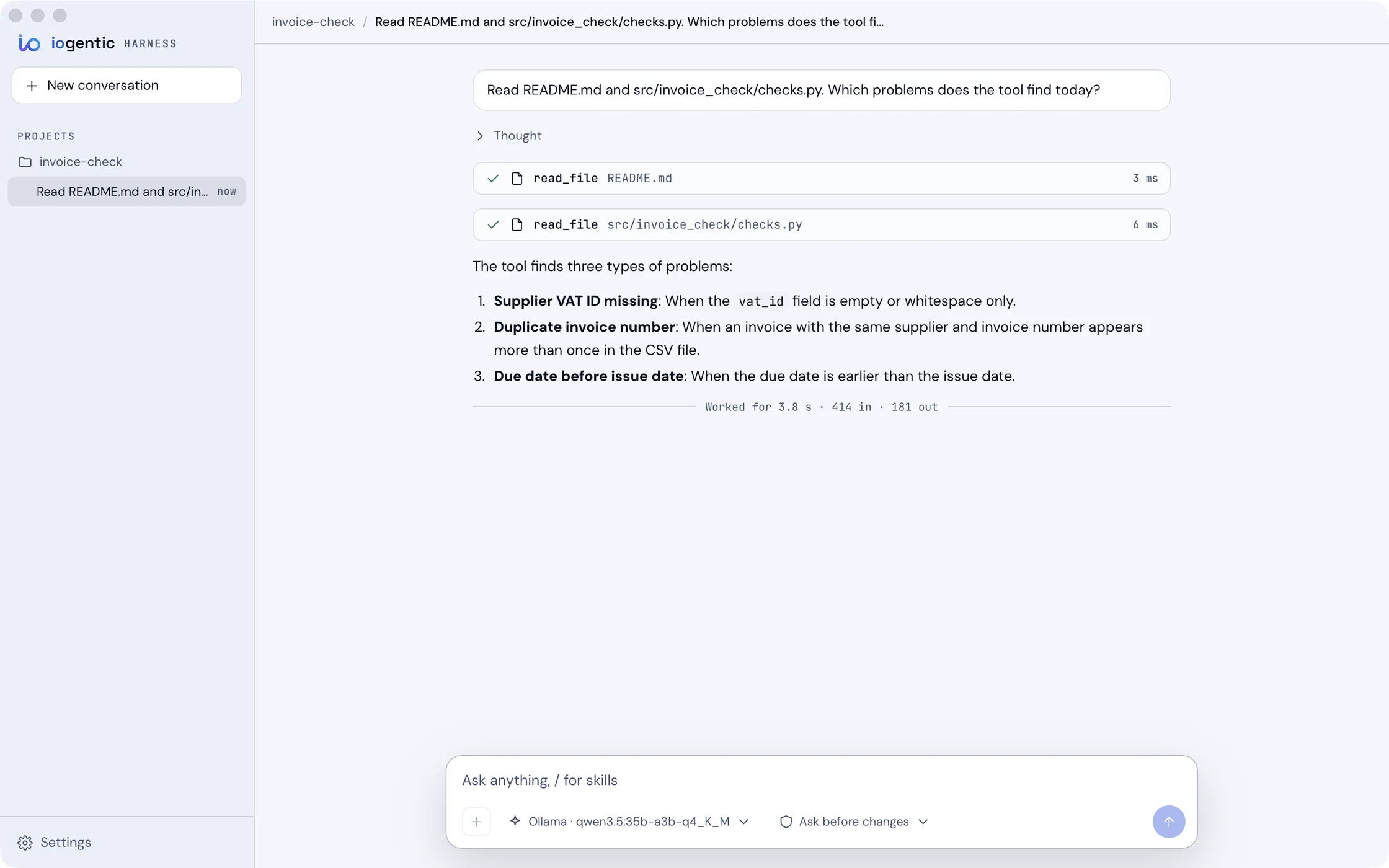
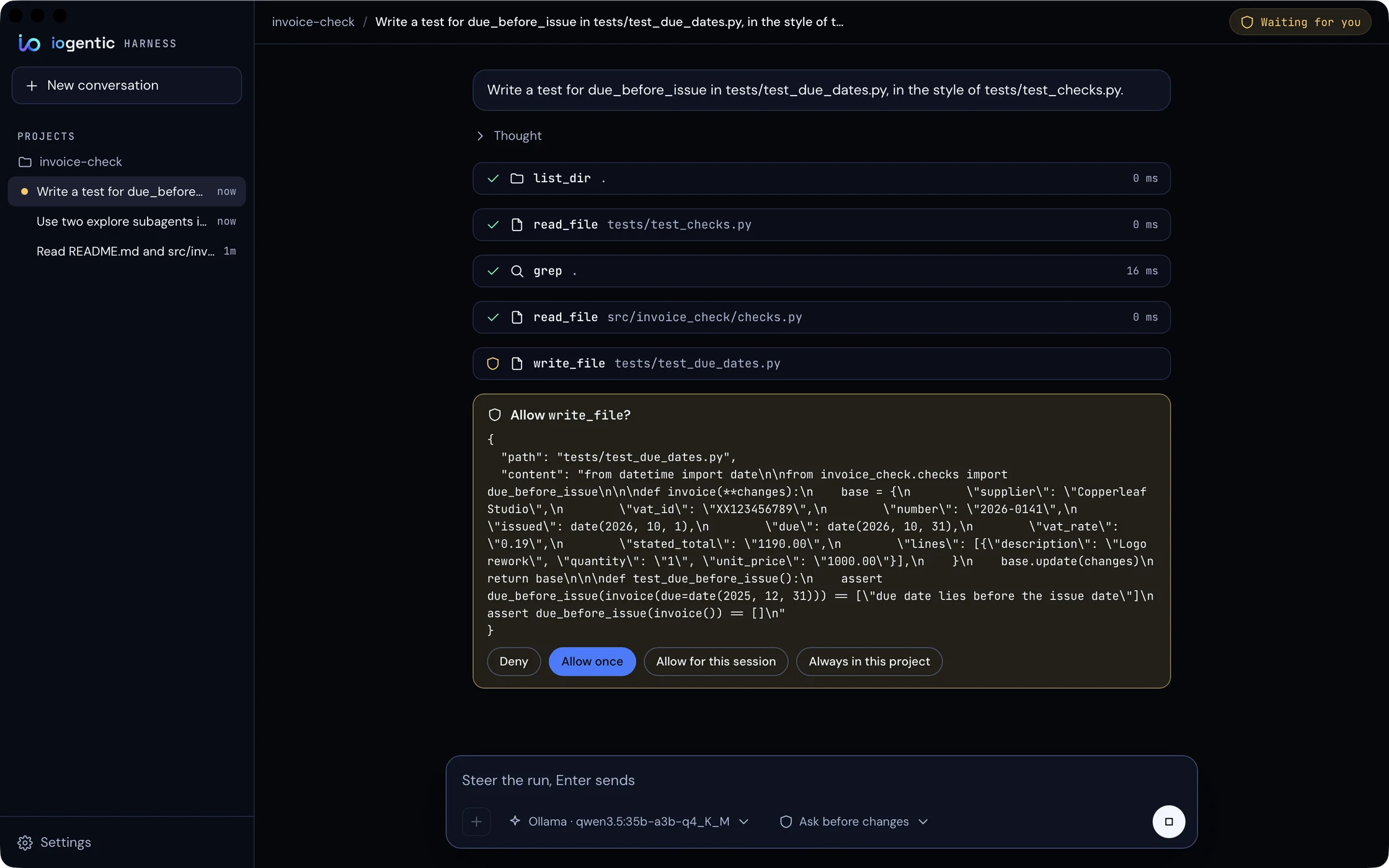
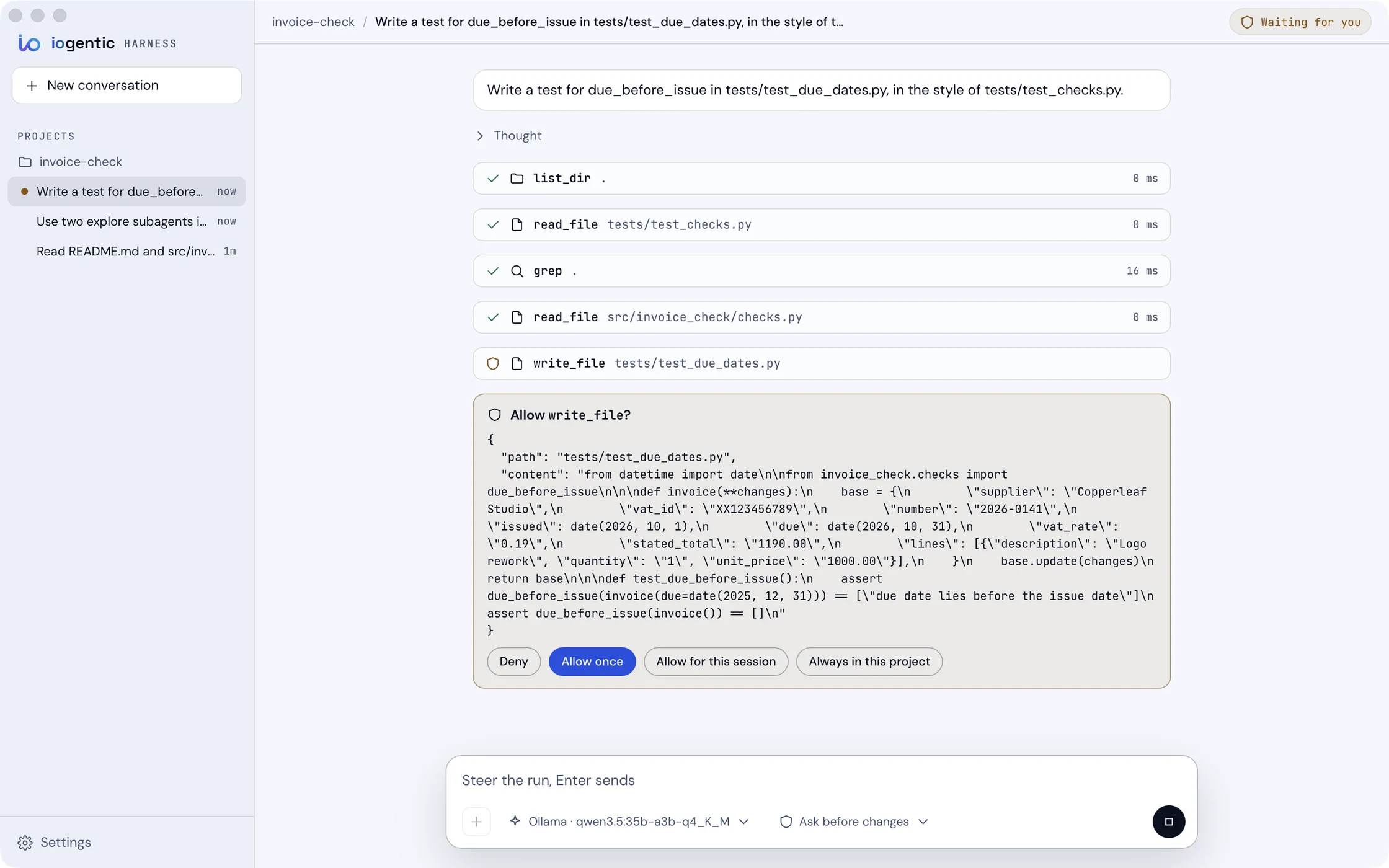
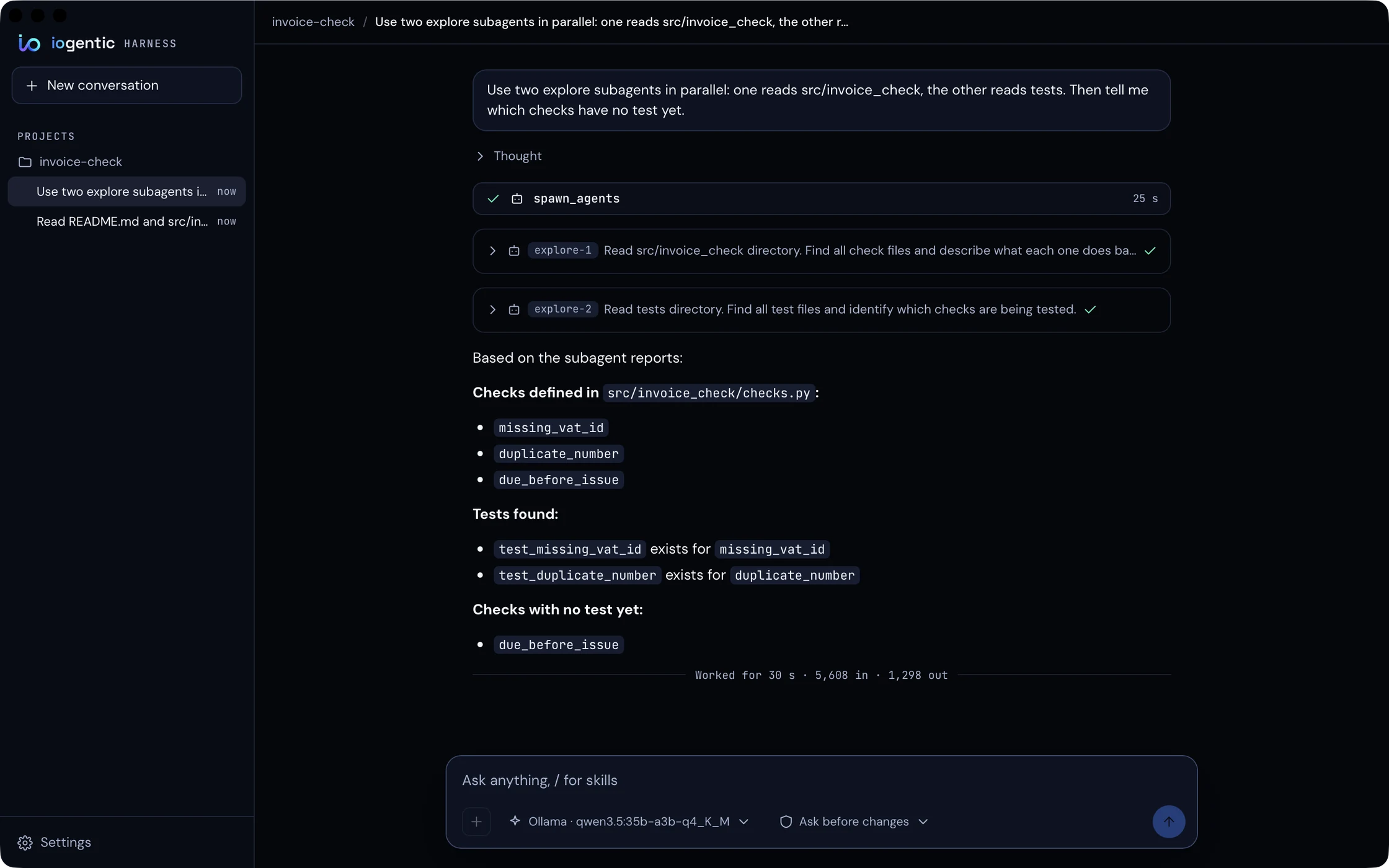
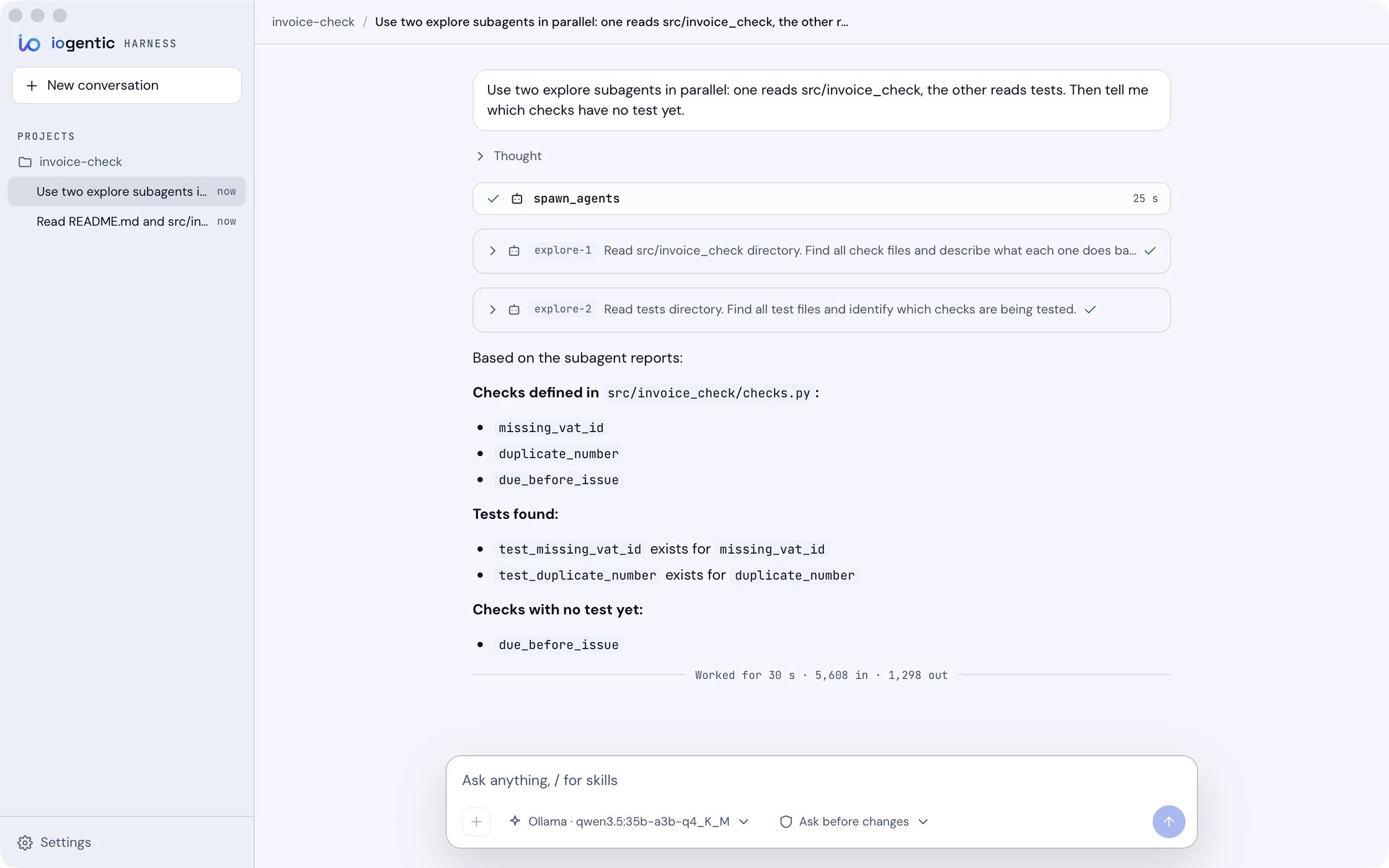
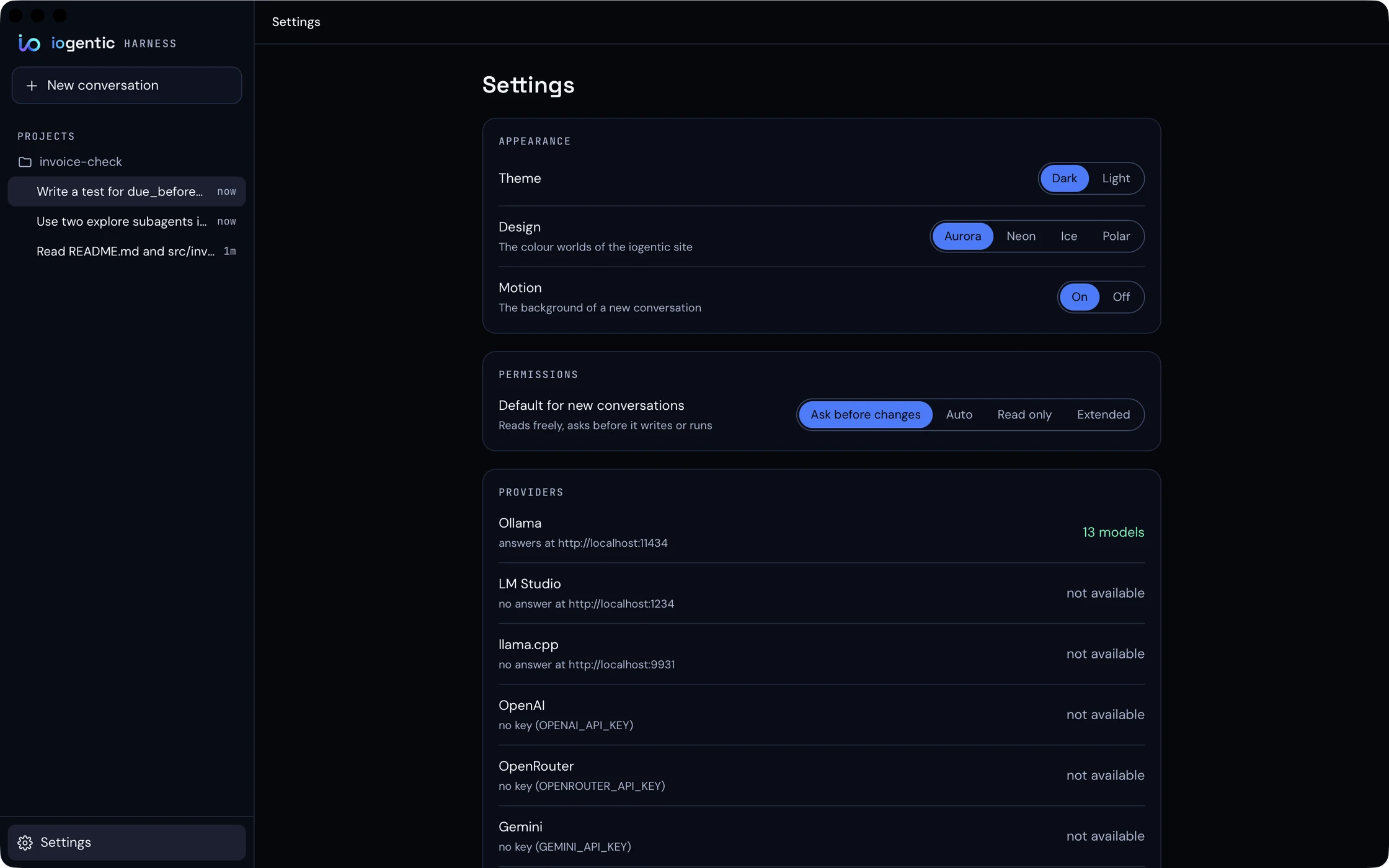
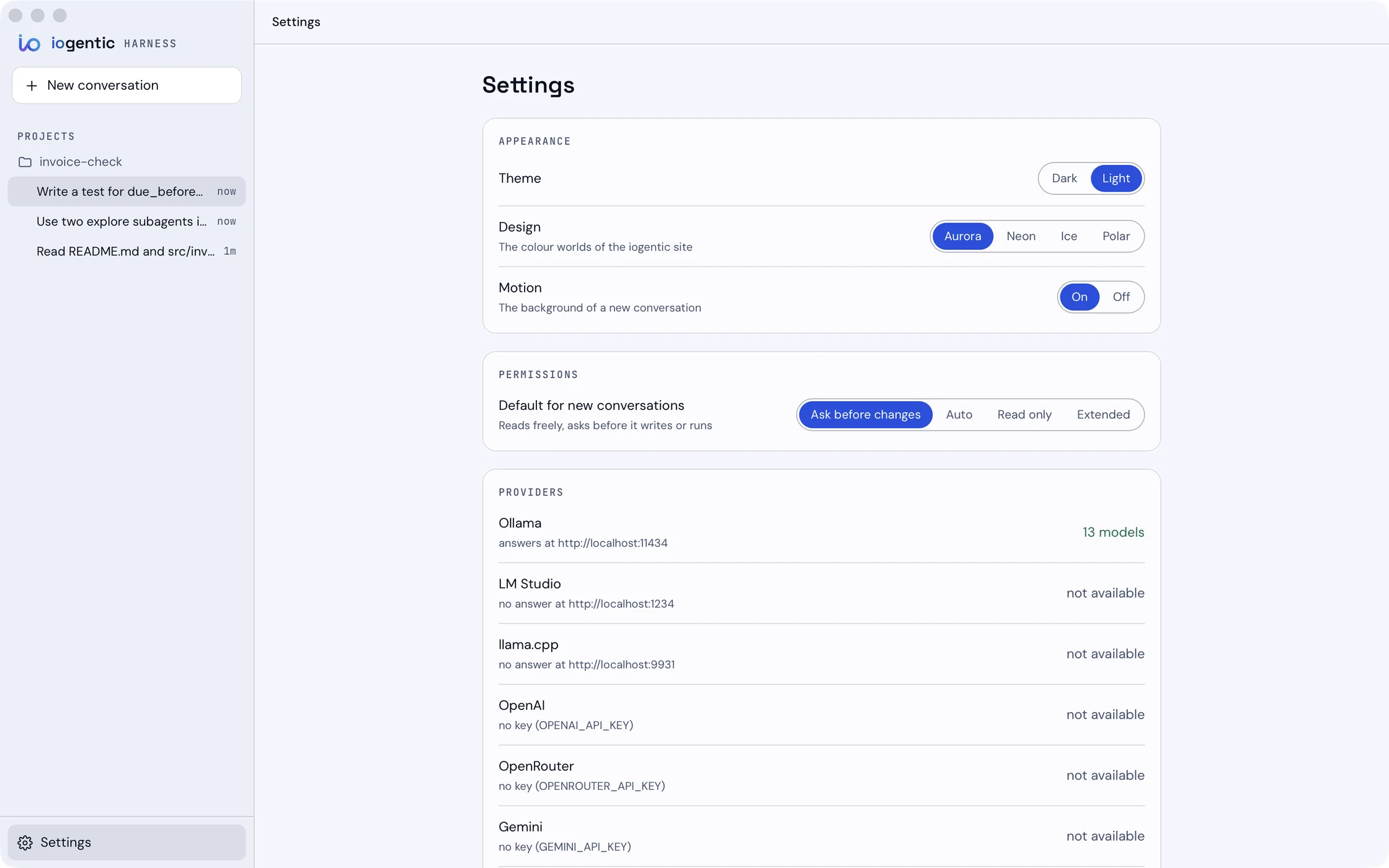
The iogentic harness is the app in which an agent is written and run. It is a native app, written in Rust, with one window. It works with local models and with hosted ones.
In development. The pictures show the app itself, with a demo project and a local model. It is not released.
A finished run in the demo project. The agent read two files and answered. Every tool call is one line with its duration.The agent wants to write a file, and the harness asks first. The answer holds for this call, for the session or for the project.Two subagents read different parts of the project at the same time. The agent puts their reports into one answer.Theme and design follow this page. The default asks before the agent writes or runs something. Local model servers are found on their own, other providers need a key in the environment.
Release gate
The release waits until every case passes.
A demo usually shows the good path once. Before a release, the agent has to pass every scenario we collected with you, and it runs them again after every change.
Harness Engineering
A harness turns an agent into something you can test. We write scenarios from real cases, run the agent against them, keep every trace, score the result against a rubric and fix what fails. The gate stays closed until the score holds.
Scenarios
Real cases with a known good outcome, including the ugly ones.Example: an application with one page missing.
Evaluations
Automated runs that score the agent on every scenario after every change.Example: 24 scenarios, run after each change to a prompt.
Traces
A record of each step, tool call and source, kept for review and replay.Example: which rule the agent cited, and where it found it.
Guards
Limits on scope, data and actions, enforced in code outside the model.Example: the agent may read the file share and may not send mail.
Replay
Run a past case again on a new version and compare the two traces.Example: last month's case, run again on the new version.
Permissions
Which tools the agent may use, on which data, and when it has to ask.Example: write access to the draft folder only.
The harness loop: scenarios, run, score, fix, and a gate that needs every case
Scenariosreal casescase 017: plan missing
Runevery change, every case
Scorethe gate needs all of them23 of 24 pass
Release gateclosed
Fixthe case that failed
becomes a scenario
Illustration. One failing case out of 24 keeps the release gate closed. After the fix, that case stays in the set for every later run.
Design, not built
Runtime
Six functions make up the runtime in this concept.
Start
iogentic pulls an artifact by digest and checks its signed verdict. An agent without a passed verdict does not start.
Sandbox
Each run gets its own workspace. Network access follows an allow-list, and time and resources have limits.
Checkpoint
When a rule asks for a person, the run saves its state and waits for the signature. It resumes from the saved state, so a long wait costs no rework.
Trace
Every step, tool call and model call is one event on one stream. The stream is the record of the run.
Replay
A recorded run can be played against a new version of the agent. The differences show before the new version is adopted.
Routing
The model is chosen per step. Local and hosted models sit behind one interface, so the operator decides where the data goes.
Simulation, sample data
Run
This is how a run would look. The agent, the invoice and the supplier are invented. No model is called and nothing is sent.
Pull
Verify
Sandbox
Work
Checkpoint
Record
State: idle
No events yet. Press Start or Step.
Run Record Sample dataPending
Run
pending
Artifact
pending
Digest
pending
Verdict
pending
Events
0
Tool calls
0
Model calls
0
Signatures
0
Made to measure
A digital brain for one job in your organisation.
We want to build for mid-sized firms and public bodies in Germany. We start from your forms, your rules and the cases your team handles every week. Then we build the smallest agent that does that one job, and we test it on those cases.
A founding team in Germany, 2026
What We Build
Three things, and they belong together. An agent for one job, an architecture sized to that job, and the harness that makes the agent testable.
Tested on real cases
Every step traced
A human signs
Model and hosting are your choice
01
Vertical agents
An agent for one job in one industry. It knows the forms, the norms and the exceptions, and it stops where a human has to decide.
A narrow scope makes the agent testable. One job has a known set of inputs, a known set of rules and a known person who checks the result.
Knows the forms and norms of one field
Asks back when a case is unclear
Hands over a draft for a person to decide
02
Custom architectures
A single prompt rarely carries a whole workflow. We split the work into an orchestrator, specialist agents, tools and an audit log, and we keep the number of parts as small as the job allows.
We pick the model per task. A large model may plan, a small local model may read out fields, and plain code does the arithmetic.
An orchestrator and specialist agents
Tools and sources declared up front
Plain code where code is enough
Open-weight models where they fit
03
Harness engineering
The scaffolding around the agent: scenarios from real cases, evaluation runs, traces, guards and replay. It is the part that turns a demo into something a team can rely on.
We write the harness before the agent is finished. Its results show when the agent is good enough to put in front of a reviewer.
Scenarios from your real cases
A score after every change
Traces a reviewer can read
Architecture
The point where a human signs is a design decision we make first. Everything in front of it is built so that the signature means something.
Inside the guards: scope, data and actions are limited
Request arrives. A form, a drawing or a mail. The agent records what it was given, for example three files and the form type.
Orchestrator plans. It splits the case into tasks. When something is missing or unclear it asks back, and the question goes into the trace.
Specialists work. Small agents with one skill each check the rule, run the numbers and write the draft. Each may only use the tools and sources declared for it.
Harness checks. Guards block actions outside the scope. The result is scored against the scenarios, and the score goes into the trace.
Human signs. The reviewer reads the draft and the trace with its sources, questions and score. Then they sign, or send it back with a note.
1 of 5
Trace: one record for the whole caseillustration
01case received
013 files read
01form type found
02plan: 3 tasks
021 question open
02asked the clerk
03rule checked
03source cited
03draft written
04guards passed
0412 of 12 checks
04score stored
05signed
05by a person
05or sent back
How We Work
A project has five steps. Each step ends with something your team can look at and judge.
Listen
We sit with the people who do the work today. We note where the time goes, which cases are routine and which need a person.
Collect cases
Together we pick real cases, the awkward ones included, and write down what a good result looks like. These become the scenarios.
Build small
We build the smallest architecture that handles those cases. Every tool, model and data source is listed before it is used.
Harness
The agent runs against all scenarios after every change. You see the score, the traces and the cases that still fail.
Hand over
Your team runs a pilot and signs off on it. We document how the agent is built, what it may do and how it was tested.
This is how we plan to run our first projects. We will adjust it to what we learn in the interviews.
Worked Example
An illustration of one agent we could build: the completeness check for a building permit application. The case is made up. The steps are the ones we would test.
InputAn application arrives as a bundle of PDF files: forms, site plan, drawings and structural documents.
SortThe agent separates the documents and names each one.
CompareIt compares the bundle with the list of required documents for this type of building in this federal state.
DraftFor each missing document it writes one line with the reason and the rule it relied on.
Hand overThe clerk sees the review sheet and decides. The agent sends nothing on its own.
Review sheetIllustration
Case 0142, residential building
Draft letter
2 of 14 documents missing
Sources
List of required documents of the state
Application form, page 2
Site plan, scale 1:500
Trace
7 files, 41 pages
2 of 14 documents missing
12 of 12 checks passed
Score
12 of 12
Open question
The structural certificate uses an older form. Accept it?
SignSend back
Fields
The method stays the same, the field is still open. Six fields on the table. None is decided. We score them this autumn and take one or two into customer interviews.
01
Security
Agents that test and defend AI systems, and the compliance work that EU product rules create for makers of connected devices and software.
Red-team tests of an agent before it goes live
An inventory of AI systems for the AI Act
exploring02
Education
AI literacy for companies, and for people who have never used an assistant. Training first, a product later if the demand is there.
Role-based training for staff who use AI
Practice cases built from your own documents
exploring03
Care
Assistants for carers, and products against loneliness for older people. Who pays is the open question.
Documentation drafts for care staff
Companion software with clear limits
exploring04
Commerce
Agents that buy on behalf of people, and shops that are ready to be found and read by agents.
Product data that agents can read
Purchase approvals with a person in the loop
exploring05
Personal products
Cards, maps and small apps generated for one person or one occasion, and thrown away after use.
Cards and maps made for one occasion
Small apps with an audit trail
exploring06
Infrastructure and administration
Agents for planning, permits and public services, where staff are short, the work follows forms, and a human signs at the end. This is where we expect the harness to matter most.
Completeness checks for permit applications
Pre-checks of grid connection documents
Site diary and protocol drafts for site supervision
first interviews
How We Decide
Each founder scores each field on six criteria, alone and before the meeting. Weighted scores decide which one or two go into interviews. The weights are a proposal until the team has changed them once.
01Desk research (done)
02First filter
03Interviews
04Decision
Criteria and weights (maximum weighted score 65)
Competence3
Customers3
Resources2
Excitement2
Market2
Timing1
Where it runs
Data, model and log can stay in the EU.
You decide per layer where an agent runs. The trace records the choice, so an auditor can check it later.
Sovereignty
An agent has four layers, and each one can be placed on its own. We connect to models through OpenAI-compatible interfaces, so the model behind an agent can usually be swapped without rebuilding the agent.
Where an agent runs: four layers, and you choose per layer
Your systems stay where they are. Inside the EU boundary sit the agent runtime, the model and the trace. For each layer there are three options. The highlighted path shows one possible setup: a data center in Germany, an open-weight model hosted by you, and a log that stays with you.
Your systemsfiles, mail, ERP
stay where they are
inside the EU
Agent runtimeagents and harness
data center in Germany
EU cloud region
your own servers
Modelchosen per task
open weights, self-hosted
EU-hosted model service
API, EU region, opt-in
Trace and logthe record of each case
stays with you
export as files
you set retention
Illustration of one setup. Which option fits depends on your data, your rules and the task.
Compute in Germany
Capacity for AI is being built in Germany right now. These are public facts we checked at the source. None of these companies is a partner or customer of ours.
Lübbenau, Brandenburg
Schwarz Digits, the IT arm of the Schwarz Gruppe, broke ground for a data center in November 2025: 11 billion euros in total, about 200 megawatts at first and room for up to 100,000 GPUs. The first phase is due by the end of 2027, and STACKIT is to run it.
Deutsche Telekom put its Industrial AI Cloud in Munich into operation in February 2026, with nearly 10,000 Nvidia Blackwell GPUs. Telekom operates it, and T-Systems runs the platform.
HammerHAI, one of two German AI factories in the EuroHPC programme, is hosted at HLRS Stuttgart. In March 2026, EuroHPC expected it to start operation in the second half of 2026. It is aimed at startups and small and mid-sized firms, and access is free for eligible European users.
STACKIT and IONOS both offer open-weight models such as Llama 3.3 70B and GPT-OSS 120B through OpenAI-compatible interfaces. STACKIT's model service runs in its region eu01 in Germany. IONOS states that all inference runs in its German data centers and that prompts are not logged or used for training.
The bans and the AI literacy duty apply since 2 February 2025, the rules for general-purpose models since 2 August 2025 and the transparency rules since August 2026. High-risk systems must keep automatic logs (Article 12) and allow effective human oversight (Article 14). For the high-risk uses in Annex III these rules apply from 2 December 2027, after the AI Omnibus moved the date. In Germany the KI-MIG of 22 July 2026 names the Bundesnetzagentur as market surveillance authority.
What the harness contributes
Every case leaves a trace with its steps, sources and score, and the sign-off records who decided. Guards stop actions outside the scope. Whether a use case is high-risk is a legal question for each case.
Requirements for an AI management system in organisations that provide or use AI. Certification is voluntary and done by independent bodies. EN 18286, the first harmonised standard under the AI Act, is designed to sit on top of standards such as ISO/IEC 42001.
What the harness contributes
Evaluations, traces and the audit log are the kind of operating evidence such a management system asks for. We hold no certificate.
The OWASP Top 10 for LLM Applications 2025 lists prompt injection first and excessive agency sixth. In December 2025 OWASP added a Top 10 for agentic applications. BSI and ANSSI recommend authorisation, input and output limits, sandboxing and monitoring for systems built on LLMs.
What the harness contributes
In our design, permissions and guards sit in code, outside the model. Each tool gets the smallest permission it needs, actions with an effect outside the agent need a person's approval, and injection attempts are part of the scenario set.
We are not lawyers and we hold no certificate. Whether a use case is high-risk, and what follows from it, is a question for your legal review. The harness supplies the records for that review.
Sources
The facts on this page and where we checked them. Checked on 22 and 23 October 2026.
No. We are a founding team in the interview phase. We want to understand the work first and pick one field before we build for customers.
Do you train your own models?
No. We use existing models, including open-weight models that can run on your hardware or with a host in the EU. Our work is the agent around the model and the harness that tests it.
What happens when the agent is wrong?
It will be wrong sometimes. A person signs every result, so a wrong draft can be caught before it leaves your team. The failed case becomes a new scenario, and every later version has to pass it.
Where does our data go?
The design goal is that data goes only where you approved it. Agent runtime, model and log each have options inside the EU, and the trace records which ones a case used.
Is this AI Act compliant?
Compliance depends on the use case and on your organisation, so a product cannot promise it on its own. The harness produces logs, test records and a recorded human sign-off, which are records of the kind the AI Act asks for in high-risk uses. Your legal review decides the rest.
Do we need an AI team?
No. You need people who know the work and can tell a good result from a bad one. They help us write the scenarios, and they review the results.
What does it cost?
We have no price list yet. We will scope the first projects together with the teams we work with.
Funkeltronic
Team
Five founders. Profiles follow once each of us has written one, which is slower than building a website.
Between us: software architecture, AI enablement in large organisations, product work, and contacts in energy, utilities and local government. Roles for the evaluation phase: idea owner, market research, customer access, prototyping, and process.
Software architecture
Systems designed for teams that have to run and change them for years.
AI enablement
Bringing AI into large organisations, with training, rules and the people who will work with it every day.
Product work
Turning a vague need into something a team can test and decide on.
Field contacts
People in energy, utilities and local government who tell us where their work slows down.
Our questions
Which cases take the most time in your team?
Where does a person have to sign, and what do they check first?
Which rules decide what counts as a good result?
What would an agent have to prove before you let it draft anything?
Names, the split between the products and the look can still change.
Talk to Us
If you run a team where the work follows rules and forms and someone has to sign at the end, we would like to hear what slows you down. Thirty minutes, no slides.